The rules of the game
Model, contracts, relationships, generic interfaces, controls, plans, receipts and audit. The Product defines how an operational domain is described and governed; it does not contain a customer's endpoints or credentials.
CIGP's strength is not a list of scripts or a separate console for each vendor. It describes objects, relationships and rules consistently, then connects reusable technical capabilities to a customer's real systems.
That is how a new technology can be introduced without becoming another vertical feature, and without confusing an available capability with permission to use it.
Model, contracts, relationships, generic interfaces, controls, plans, receipts and audit. The Product defines how an operational domain is described and governed; it does not contain a customer's endpoints or credentials.
Versioned definitions, adapters, mappings, readers, writers and templates for a technical family. It brings the specifics needed to read or change a system; it does not, by itself, enable a customer target.
Systems, connections, assets, data, credential references, selections, applied rules and actual delegations. Here a compatible capability is configured and authorized for a real context.
Adding a definition does not magically create an integration. A real write requires an attested technical capability, coherent configuration and authorization for that target.
Define the objects, their attributes and how they relate to other objects.
A library makes mappings, reading, writing or views available for that technology.
The Instance connects the real system, targets, connections, credential references and rules.
Functions consume only what the model and installed capability actually make available.
This is not a promise of “no development”: a new technology may need integration work. That work stays focused and reusable rather than becoming yet another separate application.
DataSource names the domain capability, DataSourceSystem the concrete system, and DataLayer the governed records. The contract describes identity, attributes and allowed operations; references declare how objects connect, including across DataLayers.
These definitions form a shared basis for functions that support them. Observing context, preparing an action, applying a rule or building a document does not require inventing the meaning of the data every time.
A description does not execute a change by itself. Acting on a target still requires an attested technical capability, a real system binding, controls and authorization.
The shape of views and availability of actions come from contracts and actual capabilities, not from a new page built for every product.
View connected assets and data, explore their context and open authorized interactive connections. It does not create, change or provision.
Select one or more targets and present the mutative actions actually available for that object, with fields, a plan, checks and results.
Combine actions from the same model into procedures with stages and dependencies, without creating a parallel way around delegation and controls.
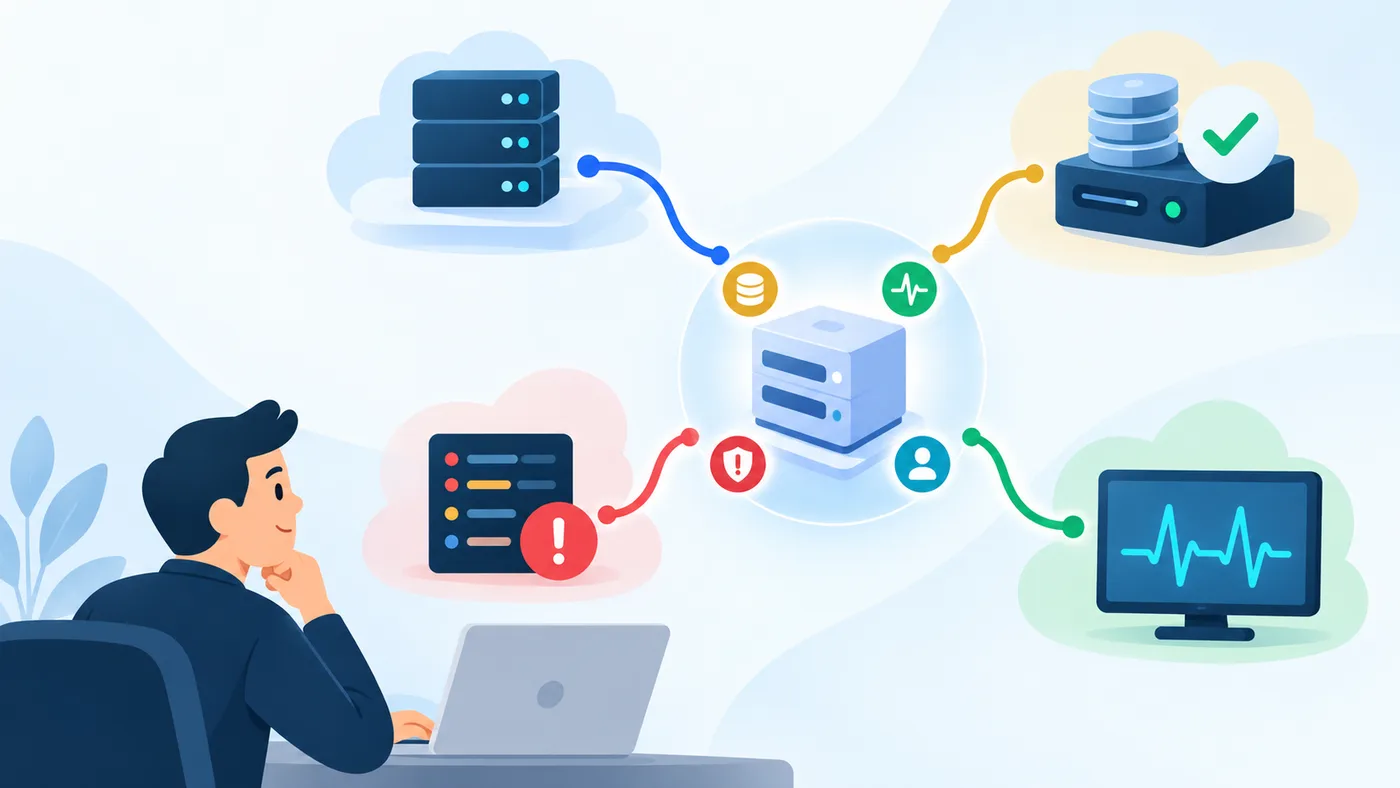
A virtual machine can be linked to its backup job, the most recent result, monitoring status and security observations derived from SIEM events. Each item retains its provenance and meaning; the relationships make the service legible.
The same references can support observation, target selection, rules, verification and documentation, according to the capabilities available in the Instance.
The platform resolves what is available for that kind of object and for the specific system. The operator sets the scope; the technical capability performs the intervention only after the relevant checks.
An action does not appear merely because a DataLayer is writable. Coverage, an attested writer, binding, policy and consistent authorizations are also required.
Collects and reconciles observations, identities and provenance so assets become part of operational context.
Rules can intervene before an action; periodic compliance assessment is a separate job.
Reuses data, relationships and rules for versioned, traceable documents, to be reviewed and approved by responsible people.
A conversation about a real situation is the quickest way to see how the shared model, reusable capabilities and Instance configuration work together.
Discuss a critical process